Skip to content




Choosing the right kitchen cabinets comes down to four things taken in order: work out how you genuinely use the kitchen, pick the tier that fits your space and budget, choose durable box materials such as plywood, and settle on a style that will still look right years from now. Handle those in that sequence, with function leading and looks following, and the whole decision stops feeling overwhelming. The kitchen cabinets Los Angeles homeowners end up happiest with are almost always the ones planned around real daily habits rather than picked off a showroom wall on appearance alone.
It is genuinely worth slowing down at this stage, because cabinets take the biggest share of most kitchen budgets and carry much of the visual weight in the room, so a rushed choice usually means paying to redo the work sooner than you ever planned. If you are still shaping the wider project rather than just the cabinets, a full overview of the kitchen renovation process is a sensible place to begin before you circle back to these details.
Key Takeaways
- Choosing cabinets really comes down to construction quality, how well they suit your layout, and your budget, with the look of them following naturally once those three are settled.
- The biggest single cost driver is the tier you pick, running from ready-made stock through semi-custom to fully bespoke, and the right one depends entirely on your space and your priorities.
- Plywood boxes generally outlast the cheaper materials, which matters a great deal in older LA homes and in properties closer to the coast.
- Shaker doors remain the safest style choice because they have stayed in favor for generations without ever dating quickly.
- Refacing can be a genuinely smart saving when your existing boxes are sound and the layout already works the way you need it to.
Start With How You Actually Use Your Kitchen
The first step in how to choose kitchen cabinets has very little to do with door samples and almost everything to do with the way your kitchen gets used across a normal week. Paying attention to your own habits tells you what storage you need, where it should sit, and which features are worth spending on. Style still matters, of course, though it tends to fall into place far more easily once the practical side has been sorted.
Walk your kitchen and watch what actually happens in it. Notice where you set the groceries down, where the trash lives, and whether your sheet pans have a proper home or end up wedged sideways somewhere that irritates you every time. A household that cooks most evenings will want deep drawers for pots and easy-reach spice storage, while a family with young children often benefits from lower cabinets the kids can actually open. Someone who entertains regularly wants glassware and serving pieces close to where the drinks get poured.
This is also the point where cabinet planning meets kitchen planning, since the two feed into each other constantly. It is worth understanding how your kitchen layout shapes daily storage before you commit to where the cabinets go, because a compact galley kitchen in a Valley Village bungalow has very different storage math than an open-plan remodel built around an island.
Custom, semi-custom, or stock: the tier that sets your budget
When you compare custom vs stock kitchen cabinets, you are really choosing between three tiers, and that single choice sets your price, your timeline, and how closely the finished cabinets hug your walls. Stock is the most affordable and the quickest to arrive, semi-custom sits comfortably in the middle and suits the majority of remodels, and full custom is built to your exact space at the top of the price scale. Here is how the three compare once you get into the detail.
Stock cabinets
Stock cabinets arrive pre-made in fixed sizes, finishes and door styles, which is what keeps them affordable and fast to get hold of. The compromise is fit, since set dimensions mean you cover any awkward gaps with filler strips, and your choice of finishes and interior organizers stays fairly limited. For a rental, a straightforward layout, or a genuinely tight budget, stock still does a perfectly reasonable job.
Semi-custom cabinets
Semi-custom cabinets start from standard sizes but open up real choice on door style, finish, depth and interior storage, which is exactly why most LA kitchens end up here. You gain plywood box upgrades, soft-close hardware and clever pull-outs, along with a finish that reads very close to bespoke without carrying the bespoke price. As long as your walls are reasonably square and your dimensions fairly standard, this tier usually delivers the best balance of quality and value you will find.
Custom cabinets
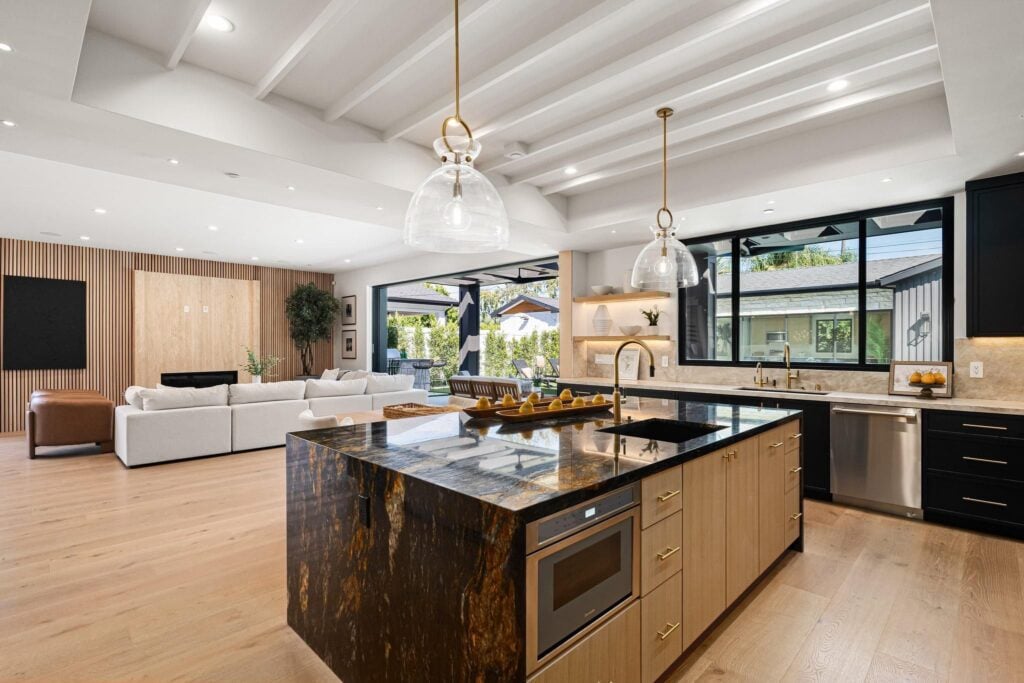
Custom cabinets are built entirely from scratch to your exact wall dimensions, your chosen wood, finish and hardware, and they carry the highest price precisely because of that. They earn their place when a kitchen has awkward angles, unusually tall ceilings, a large island, or storage needs that nothing off the shelf can solve. Plenty of older properties involved in kitchen renovation work around Pasadena and the remodeling of older Altadena kitchens have unusual wall runs and non-standard heights, which is the exact situation where building to measure makes all the difference.
Framed or Frameless Construction
The other construction decision worth understanding is whether your boxes are framed or frameless, since it shapes both the look of the kitchen and how much usable room you have inside each cabinet. Framed cabinets carry a face frame across the front of the box in the traditional American style, whereas frameless designs drop that frame so the doors sit across the whole front. Neither approach is better in the abstract, because the right one depends squarely on the look you are going for.
Framed cabinets feel sturdy and give you that familiar classic appearance, though the frame does eat slightly into the opening. Frameless cabinets, sometimes called full-access or European, give you marginally wider drawers, easier reach, and a cleaner, more modern face. If you are leaning toward a sleeker, contemporary feel, it helps to spend some time with current kitchen design directions and ideas while you settle on the cabinet face that suits the rest of the room.
The Best Kitchen Cabinet Materials for a California Home
The best kitchen cabinet materials are simply the ones that last and cope well with your kitchen’s conditions, which across much of LA means paying real attention to heat and moisture. Plywood boxes are the durable, dependable choice, MDF suits painted doors very nicely, and cheaper particleboard is usually the first thing to give way once water gets to it. Solid wood looks beautiful on stained doors, keeping in mind that it can move a little as the humidity shifts through the year.
Here is the plain version of what each material brings:
- Plywood boxes hold hardware securely and shrug off moisture better than most alternatives, so the upgrade is almost always money well spent.
- Solid wood doors and drawer fronts suit warm, natural stained looks, provided you accept that they respond to humidity swings over time.
- MDF doors stay smooth and dimensionally stable, which makes them ideal whenever you want a clean painted finish with no visible grain showing through.
- Particleboard is the budget filler, and it is best kept well away from sink-base cabinets where the occasional leak is most likely to happen.
If your home sits closer to the coast, in areas such as Redondo Beach and the wider South Bay, the salt air and damp are genuinely worth designing around, so leaning on plywood boxes and quality finishes keeps your cabinets from swelling or warping as the seasons turn. Homes further inland deal with bigger temperature swings instead, which is one more reason the cheapest particleboard tends to disappoint people down the line.
Kitchen Cabinet Styles That Hold Up Over Time
With kitchen cabinet styles, the safest bet is a look that has already proven it can last, and Shaker is the clearest example of that staying power there is. Slab, or flat-panel, doors work beautifully for modern kitchens, while inset doors carry a high-end feel and cost rather more to build and fit. Trend-chasing is usually where homeowners come unstuck, and it is the one habit worth resisting.
Shaker doors have been around for well over a lifetime and still read as fresh, which is precisely why they remain the default recommendation for most homeowners. Slab doors give you that clean, handleless, modern appearance, while inset doors, where the door sits flush inside the frame, look genuinely refined and need a skilled installer to get the reveals sitting right.
On color, soft whites and off-whites still lead the way because they stay flexible and brighten smaller kitchens, though warmer neutrals, gentle greens and natural wood tones have grown noticeably more popular of late. A two-tone treatment, with a darker base and lighter uppers, hides everyday wear nicely and adds a sense of depth to the room. One honest word of caution is that the bolder the color, the faster it can start to feel dated, so if you fall for a strong shade, place it somewhere easy to change later on, such as an island. Whatever finish you settle on, make sure it sits comfortably alongside the countertop material you pair with it, since those two surfaces share the room and quietly set its overall mood.
Should You Reface or Replace?
If your cabinet boxes are still sound and the layout already works, refacing genuinely deserves a serious look, because it keeps the boxes in place and swaps only the doors, drawer fronts and hardware for a noticeably smaller outlay than a full replacement. Replacing pulls everything out and starts over, which is the right move when the bones of the kitchen are the actual problem. The decision really turns on the condition of what you already have to work with.
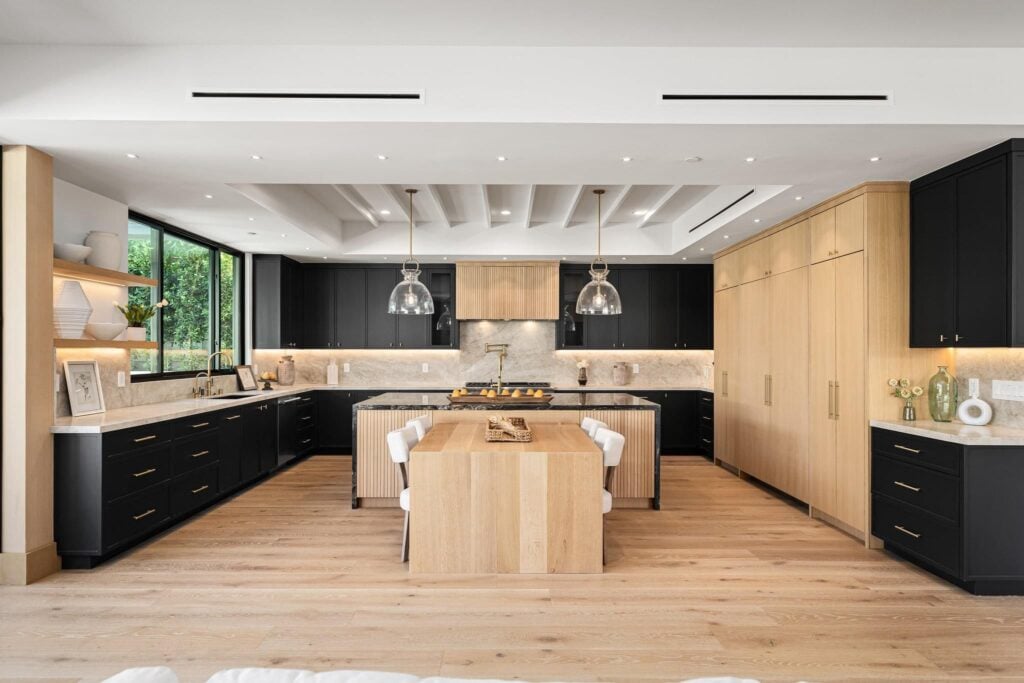
Refacing works well when the boxes are sturdy, the kitchen flows properly, and you mainly want a fresh face on the space. Replacing becomes the better route when the layout is wrong, the boxes are water-damaged or coming apart, or you are changing the footprint of the kitchen altogether. There is little sense in fitting new doors onto cabinets that are structurally past their best, and no amount of refacing will ever fix a kitchen that was laid out badly in the first place.
What kitchen cabinets cost in Los Angeles
The honest answer on the kitchen cabinet cost Los Angeles homeowners can expect is that it varies a great deal, because so much depends on the choices you make rather than any single fixed rate. As a broad guide, stock cabinets sit at the more affordable end, semi-custom occupies the middle ground, and full custom carries the highest price, though these are general estimates rather than firm quotes. Your real figure only becomes clear once the size of your kitchen, the materials, the complexity of the layout and the finishes you have in mind have all been measured and talked through properly.
A handful of things tend to shift the total in ways people do not always anticipate. Islands are usually priced on their own because they take more work to build and install, upgrades such as soft-close hardware add a little on top, and clearing out and disposing of the old cabinets carries its own modest cost as well. None of these amount to much in isolation, yet taken together they are worth accounting for early rather than as a surprise.
Because every kitchen is genuinely different, treat any range you come across online as a rough starting point rather than a promise, and get a proper quote based on your actual space before you plan your budget around a number. If the upfront outlay is the sticking point, it is worth asking about financing that spreads the project across manageable payments, and for a fuller sense of how the wider job comes together, what a complete kitchen remodel involves sets out the whole process from first visit to final walkthrough.
Case Study: A Small North Hollywood Kitchen, Reworked
A North Hollywood couple first came to Top Of Mind Home Remodeling with a cramped, closed-off kitchen from an older build, all dark cabinets, very little counter space, and a wall that cut the kitchen off entirely from the living room. They cooked most evenings and hosted family on weekends, so the space worked against them more or less constantly. What they actually needed was storage designed around their real habits, which is why so many custom kitchen remodeling projects in Los Angeles begin with a conversation about daily routine long before anyone starts talking about door colors.
We opened up the wall to connect the kitchen to the living area, then built the storage around the way the couple genuinely cook rather than around a template. The plan came together along these lines:
- Semi-custom Shaker cabinets in a soft, warm white, built on plywood boxes with soft-close mechanisms throughout the run.
- Deep drawers positioned right beside the range for pots and pans, along with a pull-out pantry that replaced an awkward and largely wasted corner cabinet.
- A modest island offering both seating and extra storage on the living-room side of the newly opened space.
- Quartz counters and recessed lighting chosen to keep the whole area feeling bright and connected.
The cabinets sat in a sensible part of the semi-custom range, which kept the budget grounded while still delivering the fit and finish of a far pricier kitchen. The real victory was not the look, satisfying as that was, but the simple fact that everything finally had a proper place to live. That, in the end, is the entire point of getting your cabinets right.
We handle this kind of work right across the region, including kitchen updates in Sherman Oaks homes and the kitchen remodeling in Burbank that keeps homes current, and the approach stays the same every single time, which is to understand how you live and then build the cabinets around it.
A Few Mistakes We See LA Homeowners Make
Most cabinet regrets trace back to the very same habit, which is choosing the look first and sorting out the function later, or quietly cutting corners on the parts of the cabinet nobody ever sees. A little planning at the outset saves both money and no small amount of frustration further down the road.
- Buying on door style alone is a common trap, since a beautiful door on a weak box is only ever a short-term win, so it always pays to check how the box itself has been built.
- Ignoring the layout rarely ends well, because new cabinets simply will not rescue a kitchen that flows badly, and the layout deserves to be solved before anything else.
- Skipping soft-close mechanisms and organizers to save a little at the outset tends to backfire, as these features are inexpensive at the point of ordering and a real nuisance to add on afterwards.
- Over-personalizing the permanent surfaces can hurt both your resale value and your own patience, so it is far wiser to keep the fixed elements calm and add personality where it stays easy to change.
- Forgetting to measure for appliances causes entirely avoidable headaches, particularly with panel-ready fridges and built-ins that need precise cabinet dimensions confirmed well before anything gets ordered.
Frequently Asked Questions
How much do kitchen cabinets cost in Los Angeles?
Cabinet pricing depends heavily on the tier you choose and the specifics of your kitchen, so stock sits at the affordable end, semi-custom in the middle, and custom at the top of the scale. Any figure you see online should be treated as a general estimate only, since your real cost becomes clear once your kitchen’s size, materials, layout and finishes have all been assessed properly.
What are the most durable kitchen cabinets?
Cabinets built on plywood boxes with solid wood or MDF doors tend to last the longest, largely because plywood holds hardware well and copes far better with moisture. That resilience matters most in older homes and in properties nearer the coast, and it is always wise to keep particleboard away from sink-base cabinets where leaks are most likely to occur.
Should I reface or replace my kitchen cabinets?
Refacing is the sensible choice when your boxes are still solid and the layout already works, as it refreshes the look for considerably less than a full replacement would. Replacing makes more sense when the cabinets are damaged, the layout is genuinely wrong, or you are changing the footprint of the kitchen.
How long do kitchen cabinets last?
Well-made cabinets can last for many years under normal use, and the quality of the box construction and finish makes the biggest difference to how long they hold up. How well they cope with your particular kitchen’s heat and humidity also plays its part over time.
Are Shaker cabinets still in style?
Yes, Shaker has held onto its popularity for generations because its clean, simple lines suit almost any kitchen you put them in. It remains the safest choice for anyone who wants a look that will not feel dated a few years from now.
Ready to Choose Cabinets With Someone in Your Corner?
Choosing kitchen cabinets feels far more manageable when you have someone experienced standing in your corner. At Top of Mind Home Remodeling, we are a family-owned team that has spent years remodeling kitchens right across Los Angeles, and we will talk you through the tiers, the materials and the layout so your cabinets suit your home and your budget rather than some generic template.